
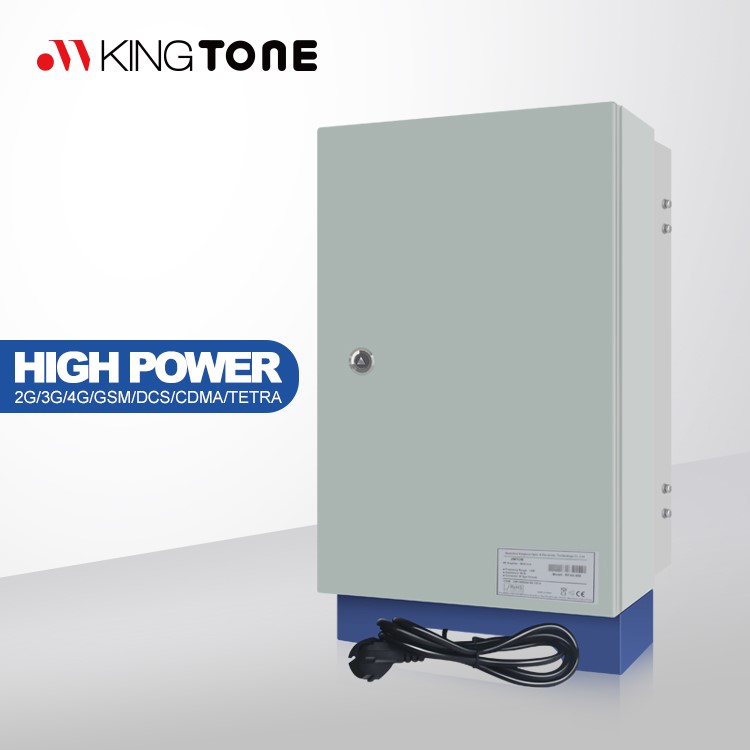


| PRODUCT NAME : | 40dbm GSM900/2100 10W Band Selective Repeater ,900 2100 dual band repeater |
| MODEL : | KT-GSM/WCDMA Repeater |
| PRODUCT CATEGORY : | Dual Band Repeater |
| POWER SUPPLY : | AC 110V、AC 220V、DC -48V、DC-24V |
| FREQUENCY : | 890-915MHz/935-960MHz、1920-1980MHz/2110~2170MHz |
| SCENARIOS : | Stadium、Office、Highway、Railway、Scenic、Pier、Island、Offshore、Urban road、Supermarket 、Metro、Rural、Suburban、Hospital、Campus、Mine、Oilfield |
| COVERAGE : | 5000sqm、1-3km、3-5km、1-5KM、5000-50000sqm |
GSM900/2100 10W Band Selective Repeaters(KT-G/DRP-B25/75-P40-B)
Kingtone Repeaters
Kingtone system is designed to solve problems of weak mobile signal, which is much cheaper than adding a new Base Station (BTS). Main operation of RF Repeaters system is to receive low‐power signal from BTS via radio frequency transmission and then transmit the amplified signal to the areas where network coverage is inadequate. And the mobile signal is also amplified and transmitted to the BTS via the opposite direction.
Telephone repeater
This is used to increase the range of telephone signals in a telephone line. They are most frequently used in trunklines that carry long distance calls. In an analog telephone line consisting of a pair of wires, it consists of an amplifier circuit made of transistors which use power from a DC current source to increase the power of the alternating current audio signal on the line. Since the telephone is a duplex (bidirectional) communication system, the wire pair carries two audio signals, one going in each direction. So telephone repeaters have to be bilateral, amplifying the signal in both directions without causing feedback, which complicates their design considerably. Telephone repeaters were the first type of repeater and were some of the first applications of amplification. The development of telephone repeaters between 1900 and 1915 made long distance phone service possible. However most telecommunications cables are now fiber optic cables which use optical repeaters (below).
Cellular repeater
This is a radio repeater for boosting cell phone reception in a limited area. The device functions like a small cellular base station, with a directional antenna to receive the signal from the nearest cell tower, an amplifier, and a local antenna to rebroadcast the signal to nearby cell phones. It is often used in downtown office buildings.
| Items | Testing Condition | Specification | ||
| Uplink | Downlink | |||
| Working Frequency(MHz) | Nominal Frequency | 890 – 915MHz | 935 - 960MHz | |
| 1920 – 1980MHz | 2110 - 2170MHz | |||
| Gain(dB) | Nominal Output Power-5dB | 95±3 | ||
| Output Power (dBm) | GSM modulating signal | 33 | 40 | |
| ALC (dBm) | Input Signal add 20dB | △Po≤±1 | ||
| Noise Figure (dB) | Working in-band(Max. Gain) | ≤5 | ||
| Ripple in-band (dB) | Nominal Output Power -5dB | ≤3 | ||
| Frequency Tolerance (ppm) | Nominal Output Power | ≤0.05 | ||
| Time Delay (us) | Working in-band | ≤5 | ||
| Peak Phase Error(°) | Working in-band | ≤20 | ||
| RMS Phase Error (°) | Working in-band | ≤5 | ||
| Gain Adjustment Step (dB) | Nominal Output Power -5dB | 1dB | ||
| Gain Adjustment Range(dB) | Nominal Output Power -5dB | ≥30 | ||
| Gain Adjustable Linear(dB) | 10dB | Nominal Output Power -5dB | ±1.0 | |
| 20dB | Nominal Output Power -5dB | ±1.0 | ||
| 30dB | Nominal Output Power -5dB | ±1.5 | ||
| Inter-modulation Attenuation (dBc) | Working in-band | ≤-45 | ||
| Spurious Emission(dBm) | 9kHz-1GHz | BW:30KHz | ≤-36 | ≤-36 |
| 1GHz-12.75GHz | BW:30KHz | ≤-30 | ≤-30 | |
| VSWR | BS/MS Port | 1.5 | ||
| I/O Port | N-Female | |||
| Impedance | 50ohm | |||
| Operating Temperature | -25°C ~+55°C | |||
| Relative Humidity | Max. 95% | |||
| MTBF | Min. 100000 hours | |||
| Power Supply | DC-48V/AC220V(50Hz)/AC110V(60Hz)( ±15%) | |||
| Remote Monitoring Function | Real-time alarm for Door Status, Temperature, Power Supply, VSWR, Output Power | |||
| Remote Control Module | RS232 or RJ45 + Wireless Modem + Chargeable Li-ion Battery | |||


